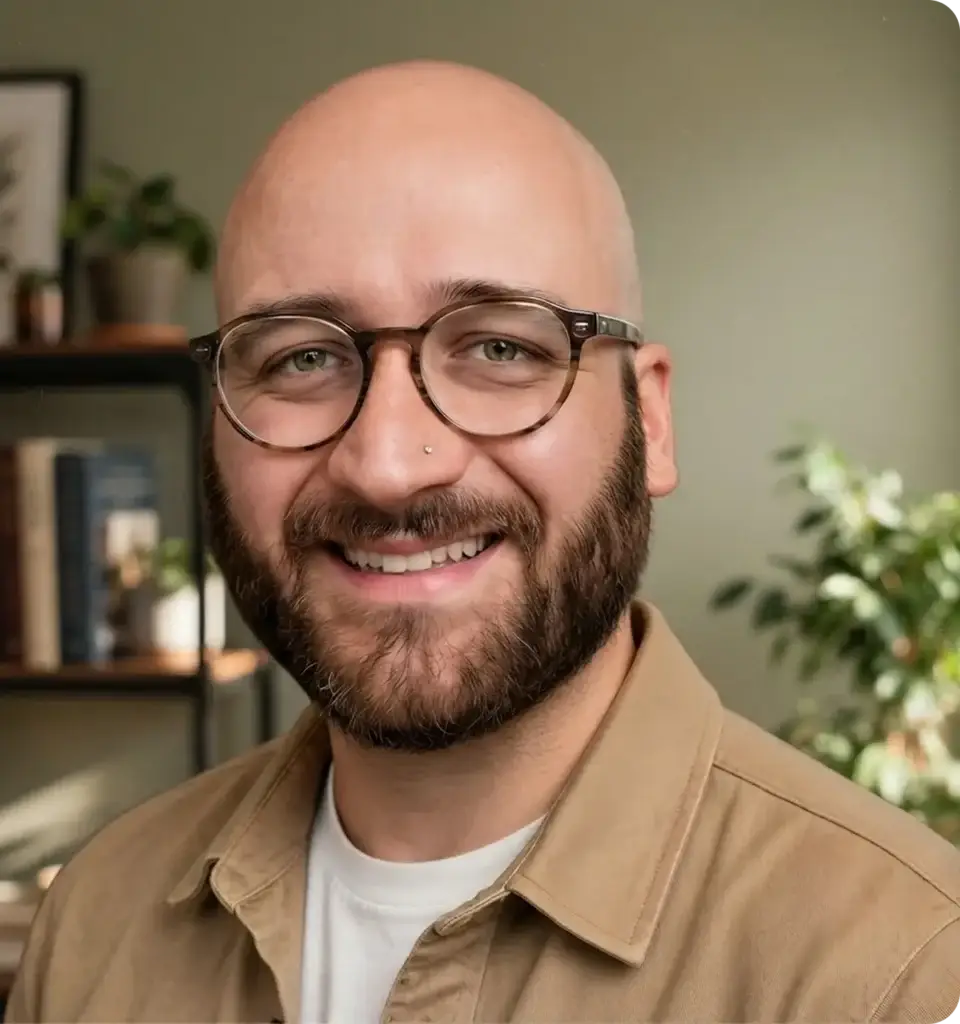
Hello,
I’m Joe Bioletti, MA, LPC.

Hello,
I’m Joe Bioletti,
MA, LPC.

I provide trauma-focused, EMDR, DBT-informed, and LGBTQIA+ affirming therapy for adolescents, adults, and queer couples in New Jersey and Connecticut.

Choosing a therapist is personal.

You may be wondering whether you will feel comfortable, whether you will have to explain parts of yourself before you can talk about what brought you here, or whether therapy will offer something beyond another place to describe what is wrong.

I want our work to feel genuine, collaborative, and purposeful. There should be room to slow down and understand what is happening, but also enough direction to help you begin doing something different with that understanding.

You do not need to arrive with the right words or know which therapeutic approach you need. We can begin with what is happening now and determine together what may fit.


You Should Not Have to Edit
Yourself to Be Understood

You Should Not Have to Edit Yourself to Be Understood

Therapy asks you to talk honestly about experiences, relationships, reactions, and parts of yourself that may already feel difficult to explain.

That becomes harder when some of your attention is spent deciding what to soften, defend, translate, or leave out.

I want therapy to be a place where we can understand your experience within the full context of your life. Your identity, relationships, family, culture, history, and environment may all matter, but no single part of you should be treated as the complete explanation for what you are experiencing.

For LGBTQIA+ clients, affirming care means that your sexual orientation or gender identity is not automatically framed as the problem. It also means we can talk honestly about identity, relationships, belonging, discrimination, family dynamics, minority stress, or safety when those experiences are relevant

You may be seeking therapy because of trauma, anxiety, OCD, emotional intensity, relationship patterns, questions about identity, or a sense that you have become disconnected from yourself. Whatever brings you here, we can begin without reducing you to a diagnosis or assuming that one therapeutic method explains everything.

You should not have to edit parts of yourself before therapy can begin.

Warmth and Honesty, With
Enough Structure
to Move
Forward

Warmth and Honesty, With Enough Structure to Move Forward

The relationship we build is central to the work.

I want you to feel able to ask questions, disagree with me, tell me when something does not fit, or slow the process down when you need to. Therapy should be collaborative, and your response to the work matters.

I also believe therapy should offer more than insight alone.

Depending on what you need, we may explore the experiences and beliefs beneath a reaction, identify triggers, strengthen emotional-regulation skills, process particular memories, or practice different ways of communicating and relating.

I will not expect you to move faster than you are ready to move. I also will not assume that every difficult subject needs to be avoided indefinitely. We can approach the work thoughtfully, honestly, and at a pace that allows it to remain useful.

Insight matters. So does what becomes possible when you begin responding differently.

The Approach Should Fit
the Person in Front of Me

The Approach Should Fit the Person in Front of Me

I do not expect every client to respond to therapy in the same way.

I draw from trauma-informed therapy, EMDR, DBT-informed skills, CBT, existential therapy, and other approaches depending on your history, goals, readiness, and response to the process.

Sometimes the work requires space to reflect and make meaning of an experience. Sometimes it requires practical skills for managing emotional intensity, tolerating distress, communicating more clearly, or interrupting an automatic response. At other times, we may focus more directly on the memories, beliefs, or experiences that continue to carry emotional weight.

The method should support the work rather than force your experience into a predetermined treatment formula.

I have worked with adolescents and adults across different clinical settings, including neurodivergent young adults and people navigating trauma, identity exploration, relationship difficulties, and complex mental-health concerns.

My experience has reinforced something I continue to bring into every therapeutic relationship: clinical knowledge matters, but it becomes useful through a relationship built on trust, curiosity, honesty, and collaboration.

AREAS OF FOCUS

EDUCATION AND TRAINING

A Little More About Me

Outside of therapy, I value creativity, connection, and having enough balance to remain present for the parts of life that matter to me.

I enjoy spending time with my partner, getting outside when I can, and unwinding with everything from horror movies to reality television.

I also share my home with a cat who occasionally decide that virtual therapy is a team effort.

Meet the Unofficial Telehealth Team

Penny

Penny is often found napping in her favorite spots, but when the zoomies strike, it’s best to stay out of her way.

In New Jersey
and Connecticut

I provide online therapy for clients located throughout New Jersey and Connecticut.

In-person sessions are also currently available at my office in Boonton, New Jersey.

You do not need to decide between online and in-person therapy before reaching out. We can discuss your location, preferences, and clinical needs during the consultation.

Online therapy is available statewide, with in-person sessions currently available in Boonton.

Connecticut

Online therapy is available throughout Connecticut. Connecticut services are virtual only.

Let’s See Whether Working Together Feels Like the Right Fit

You do not need to know exactly what kind of therapy you need before starting the conversation.

A consultation gives us a chance to talk about what has been happening, what you would like to understand or change, and whether my approach feels like a good fit for you.